
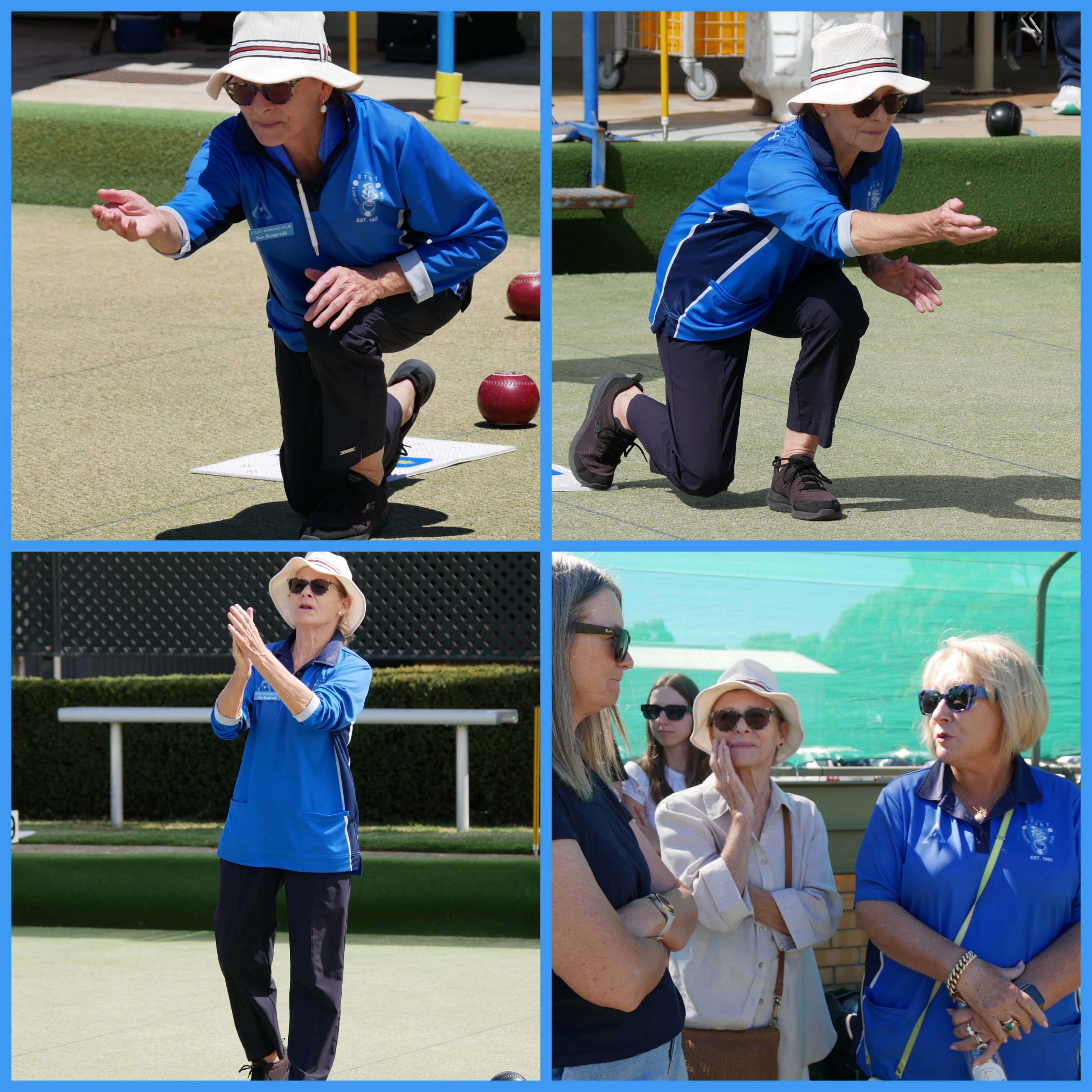
Sue Kasprzak has lived a remarkably varied life, but she talks about it with little fuss.
From learning the intricacies of legal work on the job, to working at the heart of Australian politics, travelling with Prime Ministers and later taking up lawn bowls without ever having played competitive sport, a common thread runs through her story: work hard, keep learning and give whatever you are doing your full commitment.
Sue describes loyalty, discipline, organisation and being a good listener as qualities she came to value during her years in politics. They also reveal something about Sue herself.
At Sturt, that same willingness to learn has helped her steadily develop as a bowler. Beneath the concentration — and the frown she says she was born with — is also someone who is quietly enjoying herself, enormously.
In this interview, Sue reflects on family, an extraordinary working life, some unforgettable experiences around the world, and the pleasure she has found in bowls and the friendships of Sturt.
What did you most enjoy about your childhood growing up in Melbourne?
The most enjoyable parts of my childhood were living near the beach and my high school years, which I enjoyed immensely.
Your maiden name was Challen, which reflects both English and French roots, and your husband Joe is Polish. What have you particularly enjoyed or found enriching about Polish culture and traditions?
Joe’s family were very generous and there were frequent gatherings of family and friends. Food played an important part in family life, and my father-in-law had a very large vegetable and fruit garden, which the whole family benefited from.
One particularly memorable experience was taking Joe’s parents back to Poland to visit family.
Their last contact with them was around the beginning of the Second World War, so it was a very significant trip for them.
After completing Year 12, you spent fifteen years working in the field of law and said that you learnt an enormous amount on the job. What were some of the most important things you learnt during those years?
My whole family moved to Tasmania when Dad was transferred for his work, and I started work in a law firm.
I spent about fifteen years working in various areas of law and learnt that if I used my initiative, I could expand both my abilities and the scope of my job.
There was a great deal to learn about legal documentation and processes. I enjoyed the diversity of the work and the challenge of having to be fast, accurate and well organised. Shorthand was also a very useful skill and something I used a great deal.
You subsequently worked as a Private Secretary for three Australian Prime Ministers, John Howard, Malcolm Turnbull and Tony Abbott. How did you first find your way into that quite extraordinary working environment?
In 1985, I applied for a position with the Member for Barker, James Porter. I remained with him until he retired after Ian McLachlan won preselection.
I then joined Andrew Peacock’s campaign team for the 1990 election. That was my first experience as a travelling campaign staff member.
After an election, personal staff positions are effectively reopened, and staff may apply either for their existing position or for another one.
Over the years I was very fortunate to work with a number of MPs and Senators based in Adelaide.
During the 1998 election campaign, I worked in the Coalition Tax Reform Information Service, which was a hotline answering questions from around the country about the proposed Goods and Services Tax.
I was then offered a position with the Coalition Tax Reform Legislative Unit, assisting Senators during the Senate Inquiry. That unit disbanded in November 2000.
I was subsequently asked to apply for a position as Private Secretary to the Prime Minister’s Principal Private Secretary. Among his many responsibilities was preparation for Question Time, which I found particularly interesting. It was always a race against time because of the very tight preparation schedule.
From there, I accepted a position as Private Secretary to Prime Minister John Howard.
I finished in 2007 and returned to Adelaide, only to later return to work for Malcolm Turnbull when he was Leader of the Opposition.
Following the leadership change in which Tony Abbott became leader, I was asked to stay on.
I finally left that office shortly before the 2010 election. I returned for a short time when Malcolm Turnbull became PM, and then I retired.
What did you find most demanding about working at that level of politics?
My team and I often laughed that our positions were more a lifestyle than a job.
I was working most of the time, although there were occasional quieter periods. The job really did become my life.
And what did you enjoy most about it?
I found the opportunity to see how our system of government actually works, and to learn its processes from the inside, enormously interesting. Every day brought new challenges.
I was also fortunate to be part of a large and very diverse office where the staff worked extremely well together. We simply meshed, and when everything was working well the office just hummed along.
I enjoyed the position immensely and found it exhilarating.
Travelling with the Prime Minister also gave me experiences I would never otherwise have had: dinners at the White House and the Great Hall of the People, and attending Anzac Day commemorations at Gallipoli and the Menin Gate, among many others. There were some wonderful experiences.
What did working so closely with senior political figures teach you about leadership and people in positions of power?
I think loyalty is one of the most important qualities in politics.
A good memory, being a good listener and negotiator, and being disciplined and organised are also extremely useful attributes.
It is important to be widely read as well.
What sort of life did that work involve – were you based mainly in Canberra or Sydney, or moving between different locations?
When I was working for South Australian Senators and MPs, I travelled to Canberra occasionally for parliamentary sittings.
I then stayed in Canberra for the duration of the Tax Reform Information Service and, from that point on, was based there much of the time.
During my time in the Prime Minister’s Office, I was generally in Canberra during the week and Sydney on weekends.
Joe would occasionally come to Sydney for the weekend.
Wherever the Prime Minister was, I was, and that often included the morning walks.
Joe’s clients would sometimes tell him where I was after seeing the Prime Minister on the television news!
When and why did you eventually move to Adelaide?
Before settling down, Joe and I spent almost three years overseas, eventually driving overland from London to Kathmandu.
Hobart was a bit of a shock by comparison!
We stayed there and built a home in Sandy Bay, but Tasmania was simply too cold for me, so we eventually moved to Adelaide.
I understand you had not played competitive sport before taking up lawn bowls, but you had undertaken ballet training for many years. Do you think you brought anything from your ballet experience to bowls?
I had never played a sport of any kind. I was a serious ballet student during my school years and was always excused from sporting activities.
I do think the balance and flexibility I developed through ballet have been helpful advantages in bowls.
How did you come to take up lawn bowls at Sturt?
Evie Sinclair first encouraged me to play Night Owls, which I did for about two years before giving it away.
Later, when the “Come and Try” sessions started, Evie asked whether I would be interested. I was keen to give it a try, and the fact that coaching was available was a big attraction for me.
I haven’t looked back. I just love bowls, and Sturt is such a happy and friendly club.
After your first year or two learning the game, last season you seemed to develop a new poise and consistency in your bowling. What do you think helped bring about that change?
I needed to understand the how and why of bowls, and I feel much more confident now that I understand more about the game.
My bowls are going where I want them to more often, and I am beginning to make successful corrections when things are not quite right.
I’m pleased with the progress I’ve made, and I particularly enjoy playing pennant games.
What do you most value about Sturt Bowling Club?
The Club offers a wonderful combination of friendship and social enjoyment, competition, and the opportunity to keep learning how to play the game better.
I think that continued learning is important, and the members have created a very welcoming environment where everyone feels included.
Are there one or two other things about you – interests, experiences or perhaps sides of your personality – that most people at Sturt would not know?
I have always believed that if something is worth doing, it is worth doing properly and giving it your all.
It might surprise people to know that I do, in fact, have a sense of humour, although it may not always show. I seem to have been born with a frown, while underneath I am often having a great deal of fun.
Over the years I have found an outlet in gardening, renovating, sewing and cooking.
These days, I am simply enjoying life and the freedom to decide what I feel like doing next - and then doing it.